

Struggling to get your Instagram posts discovered without adding a long list of hashtags? You’re not alone. Instagram discovery has changed, and simply attaching popular hashtags to every post isn’t a reliable growth strategy anymore.
That’s where Instagram SEO becomes useful.
Instagram SEO is about making your profile and content easier for Instagram to understand and easier for the right people to find. Instead of depending on hashtags alone, you optimize your profile name, bio, captions, content topics, and other search signals around phrases your audience uses.
This guide will show you how to optimize Instagram for search in 2026 without turning your profile into a keyword-filled mess. You’ll learn how Instagram Search works, where to place keywords, how to improve your bio and captions, and how to use alt text correctly.
The goal is simple: help Instagram understand what your content is about while keeping everything natural for real people.
| Quick Guide | Details |
| Difficulty | Beginner-friendly |
| Initial setup time | Around 30–45 minutes |
| Best for | Creators, freelancers, and small businesses |
| Main goal | Improve search visibility and organic discovery |
| Hashtags essential? | No |
Instagram SEO: How Search Discovery Actually Works
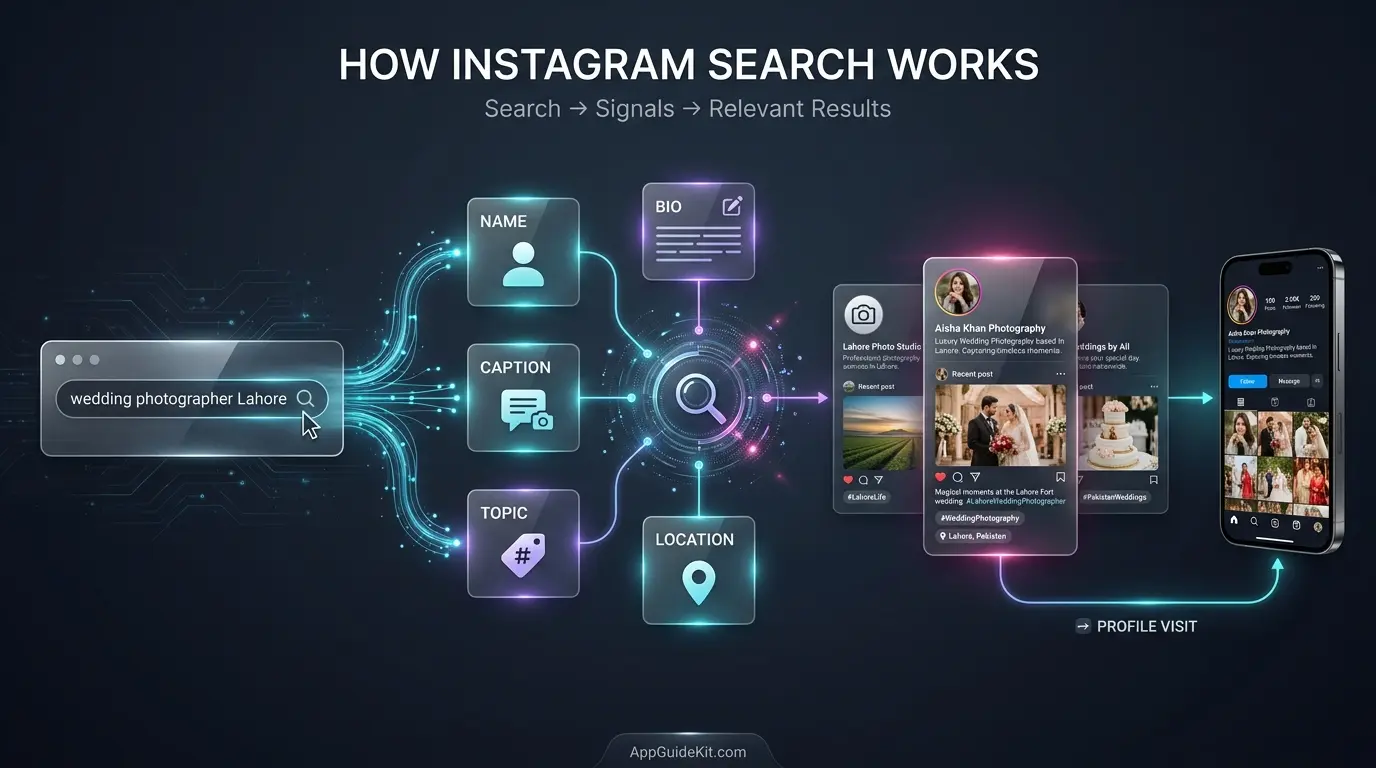
Instagram SEO is the process of optimizing your profile and content, so Instagram can connect it with relevant searches. It works by giving the platform clear information about your account, topics, and individual posts.
Instagram has explained that the words people enter into Search are a major signal. The platform can match those searches with information such as usernames, profile names, bios, captions, hashtags, and places. Search results can also vary based on a person’s previous activity and the popularity of possible results.
Here’s a simple example.
Imagine someone searches:
“wedding photographer Lahore”
Now compare these two profiles.
Profile A:
Ahmed Photography
“Capturing your special moments.”
Profile B:
Ahmed | Wedding Photographer Lahore
“Wedding photography in Lahore for couples and events.”
Profile B gives Instagram a far more useful context about the service, topic, and location.
That doesn’t guarantee that the profile will rank first. Instagram Search is personalized, and many signals can affect results. However, clearer information gives the platform a better chance of understanding when your profile is relevant.
✅ Key Takeaway: Think of Instagram SEO as clarity, not trickery. Your job is to make your topic obvious to both Instagram and the person viewing your content.
Why Hashtags Are No Longer the Main Reach Tool
Hashtags can still help describe or categorize a post, but you shouldn’t depend on them to generate reach. The stronger approach is to create relevant content that clearly communicates its subject.
In December 2025, Instagram began limiting posts to five hashtags, with Adam Mosseri emphasizing the use of a few specific tags rather than long lists of generic ones. He also reiterated that hashtags may help with search but shouldn’t be treated as a direct reach booster.
That changes how you should think about hashtags in 2026.
Instead of writing:
#marketing #business #viral #explore #growth
choose a small number of tags only when they accurately describe your content.
More importantly, make the actual post clear.
A Reel titled:
“3 Instagram Bio Mistakes Hurting Local Businesses”
already provides meaningful context.
Compare that with:
“You won’t believe mistake #3!”
The second hook may create curiosity, but it tells Instagram and potential searchers very little about the actual topic.
So, can you get views on Instagram without hashtags?
Yes. Your content can still appear through recommendations, Search, Explore, Reels, shares, and other discovery surfaces.
💡 Pro Tip: Treat hashtags as supporting labels. Don’t build your entire organic growth strategy around them.
How to Optimize Your Instagram Name for Search
Your Instagram name field should clearly communicate either who you are, what you do, or what topic your account covers. When possible, combine your brand or personal name with one useful search phrase.
A simple formula works well:
[Name or Brand] | [Main Service or Topic]
For example:
Ayesha | Home Baker Lahore
TechNest | Android App Guides
Bilal Khan | Fitness Coach
This approach keeps your identity visible while adding helpful context.
Instagram’s Search guidance specifically says relevant usernames and profile names can help the platform match accounts with search queries.
Instagram SEO Name-Field Formula
Start with your real name or recognizable brand.
Next, choose one primary topic phrase that describes your main offer.
Then ask yourself one simple question:
Would a real person naturally search for this phrase?
For example, “Graphic Designer Karachi” is clearer than a vague phrase such as “Creative Dream Maker.”
Avoid filling the name field with every possible keyword.
Bad example:
Ali | SEO AI Marketing Apps Business Growth
Better example:
Ali | SEO Consultant
The second version is cleaner, easier to understand, and more professional.
⚠️ Common Mistake: Don’t sacrifice brand recognition just to insert keywords. Searching for visibility is useful, but people still need to remember who you are.

How to Write a Search-Friendly Instagram Bio
A strong Instagram bio explains who you help, what you provide, and what the visitor should do next. Relevant keywords should fit naturally into that message.
A practical bio formula is:
Audience + Offer + Specific Detail + Call to Action
For example:
Simple Instagram and Canva tutorials for small businesses. Weekly content tips and app guides. Read the latest tutorial below.
A local business could use:
Custom birthday cakes in Islamabad. Eggless options are available. DM to check this week’s slots.
Notice how both examples sound like normal language.
They aren’t lists of disconnected keywords.
Instagram has previously recommended using relevant keywords and location information in profiles when those details accurately describe the account. Its Search system can also match words from bios with user queries.
Step-by-Step Instagram Bio Optimization
- Identify your main audience.
Decide exactly who the account serves.
- Choose your primary topic.
Pick the main service, niche, or subject you want people to associate with you.
- Add location when it matters.
This is especially useful for restaurants, salons, photographers, repair services, and other local businesses.
- Explain the benefits.
Tell visitors what they’ll get from following you.
- Finish with one clear CTA.
Ask visitors to read, shop, book, message, subscribe, or take another relevant action.
🔥 Quick Tip: Read your bio as if you’ve never seen the account before. If you can’t understand the niche within a few seconds, simplify it.

Instagram SEO Caption Strategy Without Keyword Stuffing
A search-friendly caption should clearly explain what the post is about while still sounding natural. You don’t need to repeat the same keyword repeatedly.
Instagram has publicly identified captions as one of the text areas its Search system can use when matching content with a query.
So instead of writing a vague opening such as:
“Here’s something every creator needs to know.”
you could write:
“Trying to increase Instagram reach organically? Start by fixing these three profile SEO mistakes.”
The second version still sounds like a human, but it gives a much clearer context.
A Simple Caption Formula
Use this structure:
Search-aware hook → direct answer → helpful details → example → CTA
For example:
“Want to optimize your Instagram bio for search? Start with one clear niche keyword in your name field, explain who you help in your bio, and add your location if you serve local customers. Keep everything readable rather than repeating the same keyword. Save this checklist for your next profile update.”
That caption communicates the topic without feeling forced.
You can also use closely related phrases instead of repeating your exact focus keyword.
For an Instagram SEO post, related terms may include:
- Instagram Search
- profile optimization
- organic reach
- search visibility
- caption keywords
- content discovery
The aim isn’t to hit an artificial keyword count inside every caption. The aim is to describe the content accurately.
✅ Key Takeaway: Write for people first, then check whether Instagram can clearly understand the topic.
How to Use Image Alt Text the Right Way
Instagram alt text should primarily describe the visual content of an image for accessibility. It shouldn’t become another place to dump SEO keywords.
A useful alt text description explains what someone would need to know if they couldn’t see the image clearly.
Bad example:
“Instagram SEO growth reach marketing keywords social media Instagram tips.”
Better example:
“Instagram profile edit screen showing a bakery bio with service and location information.”
The second description is specific, understandable, and useful.
If a relevant keyword naturally belongs to the description, you can include it. But there’s no need to force it.
For example:
“Instagram SEO checklist showing profile name, bio, captions, and content topics.”
That works because the phrase accurately describes the image.
Instagram’s published Search explanation clearly names fields such as usernames, bios, captions, hashtags, and places when discussing text matching. It doesn’t give the same explicit search-ranking role to alt text.
That distinction matters because some SEO guides treat alt text like a hidden keyword box. That isn’t its main purpose.
📝 Note: Use alt text for accessibility first. Any SEO value should come naturally from describing the image accurately.
Advanced Reels SEO for Maximum Visibility
Reels SEO starts by making your topic obvious as quickly as possible. A viewer—and Instagram—shouldn’t have to guess what your Reel is about.
Start with a direct hook instead of a vague introduction.
For example:
Weak:
“Here’s something you need to know.”
Better:
“Here are three Instagram SEO mistakes hurting your reach.”
The second version immediately establishes the subject and gives viewers a reason to continue watching.
A practical Reel structure looks like this:
- Open with the problem or benefit.
Tell viewers exactly what they’ll learn.
- Add clear on-screen text.
Use a short title that accurately describes the topic.
- Deliver the answer quickly.
Avoid a long introduction before providing value.
- Write a descriptive caption.
Explain the Reel using natural language related to its main topic.
- Finish with a useful CTA.
Ask viewers to save, share, comment, or visit your profile when it genuinely makes sense.
Original content also matters. In January 2026, Meta reported that 75% of Instagram recommendations in the United States were coming from original posts, after the company increased the presence of original content in recommendations during late 2025.
That doesn’t mean every original Reel will perform well. Quality, relevance, audience response, and personalization still matter.
How On-Screen Text and Audio Fit In
Use on-screen text because it makes the topic easier for viewers to understand, especially when they watch without sound.
You can also clearly say the subject while speaking in the video. However, don’t treat spoken keywords or trending audio as a guaranteed ranking trick. Instagram doesn’t publicly disclose every signal used to index and recommend individual Reels.
The safest strategy is simple: make useful original content and communicate its subject clearly in the video and caption.
💡 Pro Tip: Before publishing a Reel, ask yourself, “Could someone understand this topic within the first three seconds?” If the answer is no, improve the opening. best free AI video generators for Reels and TikTok

How to Conduct Keyword Research for Instagram
You don’t need an expensive SEO tool to start Instagram keyword research. Instagram’s own search interface can help you discover how people phrase topics inside the app.
Here’s a practical process.
Step 1: Start With a Broad Topic
Open Instagram Search and enter a phrase related to your niche.
A fitness coach might start with:
home workout
A social media creator might try:
Instagram growth
A local baker could search:
birthday cakes
Pay attention to relevant suggestions that appear while you type.
Step 2: Expand the Search Intent
Take the broad topic and make it more specific.
For example:
home workout for beginners
Instagram growth tips
birthday cakes Lahore
You’re looking for a language that closely matches what your ideal audience wants.
Step 3: Study Relevant Results
Open profiles and posts that appear for useful searches.
Look for patterns in:
- Profile names
- Bios
- Content topics
- Caption wording
- Questions addressed in posts
Don’t copy another creator’s wording. Use the results to understand the language and problems common in your niche.
Step 4: Group Keywords by Intent
A simple keyword list could look like this:
Educational: how to optimize Instagram bio
Problem-based: Instagram reach dropping
Local: social media manager Lahore
Comparison: Instagram Reels vs posts
Action-based: increase Instagram reach organically
This makes content planning much easier because each search intent can become a separate post.
Step 5: Match One Main Topic to Each Post
Don’t force ten unrelated keywords into one caption.
Choose one clear primary topic and support it with closely related language.
For example, a post targeting “Instagram bio-optimization” can naturally discuss profile keywords, the name field, niche positioning, and calls to action.
Suggested Screenshot: Add a screenshot here showing Instagram Search suggestions for one seed keyword. Blur personal account information if necessary.
🔥 Quick Tip: Keep a simple spreadsheet containing the keyword, search intent, planned content format, publication date, and performance. Over time, your own results become more useful than generic keyword lists. find low competition keywords for free

Common Instagram SEO Mistakes to Avoid
Most Instagram SEO mistakes happen when optimization starts making the account less useful for real people. Search visibility should improve clarity, not damage readability.
The first mistake is keyword stuffing.
Repeating the same phrase in your name, bio, caption, and alt text doesn’t automatically improve ranking. It can make the profile look unnatural and reduce trust.
The second mistake is targeting phrases that don’t match your content.
A small business account shouldn’t add unrelated trending words simply because those topics are popular. Traffic from the wrong audience rarely helps with long-term growth.
Another common problem is changing your niche constantly.
If you publish Android tutorials today, fitness advice tomorrow, and cooking videos the next day, it becomes harder to build a clear audience of expectations around the account.
You should also avoid copying successful competitors. Studying their topics is fine. Rewriting their captions sentence by sentence isn’t.
Finally, don’t assume every drop in reach means you’ve been “shadowbanned.” Reach can change because of competition, audience behavior, recommendation eligibility, content quality, seasonality, or normal performance differences between posts.

⚠️ Warning: There is no reliable public evidence for a specific keyword-density percentage that automatically triggers an Instagram “shadowban.” Keep your wording natural instead of trying to stay below an invented threshold.
Frequently Asked Questions About Instagram SEO
What Is Instagram SEO and How Does It Work?
Instagram SEO means optimizing your profile and content so they’re easier to understand and discover through Instagram Search and other discovery surfaces. You improve relevance by clearly describing your niche, topics, services, and location where appropriate. Search results remain personalized, so optimization can improve discoverability but doesn’t guarantee a specific ranking.
Can You Get Views on Instagram Without Hashtags?
Yes. Instagram posts and Reels can gain views without hashtags through Search, recommendations, Explore, sharing, and existing followers. Hashtags can still provide context when they’re relevant, but they shouldn’t be your only discovery strategy. Clear topics, useful content, strong captions, and audience engagement matter more than filling every post with tags.
How Do I Find Keywords for Instagram Search?
Start typing your main topic into Instagram Search and review relevant suggestions. Repeat the process with more specific versions of the phrase. Then study the profiles and content appearing for those searches to understand common terminology. Use this information for topic research rather than copying another creator’s wording.
Where Should I Put Keywords on My Instagram Profile?
Your profile name and bio are the most logical places for important account-level terms. Your name can include one clear service or niche description, while your bio can explain your audience, offer, and location. Post-specific keywords belong naturally in captions rather than being repeated throughout every profile field.
Do Hashtags Still Matter for Instagram Reach in 2026?
Hashtags can still provide useful categorization and search context, but they shouldn’t be treated as a guaranteed reach booster. A few highly relevant hashtags make more sense than a long collection of generic tags. Your main focus should remain clear content, originality, relevance, and creating posts people actually want to watch or share.
How Does Instagram Index Reels in Search Results?
Instagram doesn’t publicly reveal every technical signal used for Reel indexing. The practical approach is to make the Reel’s subject clear through its content, on-screen wording, and descriptive caption. Recommendations also use personalized ranking systems, which means different users may see different content based on their interests and behavior.
Why Is My Instagram Search Traffic Dropping?
A decline can have several causes, including stronger competition, changing search behavior, inconsistent posting topics, weaker content performance, or recommendation eligibility issues. Compare several weeks of Instagram Insights rather than judging your strategy from one post. Check whether the decline affects all content or only certain topics and formats.
How Do I Use Alt Text for Instagram Posts?
Write alt text as a useful description of what appears in the image. Include important objects, people, text, or context that someone using a screen reader would need to understand the post. Don’t turn the field into a list of SEO keywords. Accessibility should remain its primary purpose.
How Long Does It Take for Instagram SEO to Work?
There’s no official fixed timeline. Updating your profile can make your topic clearer immediately, but meaningful organic growth normally requires consistent publishing, testing, and measurement. Give yourself enough time to compare multiple posts and content themes rather than expecting a single optimization change to produce instant results.
Should I Use Keywords in Instagram Captions?
Yes, as long as they accurately describe the content. Put the main topic into the caption naturally and use related terms only when they help explain the post. A readable caption that directly answers the audience’s question is more useful than repeating the same keyword simply to increase its frequency.
Summary of Key Instagram SEO Strategies
Effective Instagram SEO comes down to clarity, relevance, and consistency. You want Instagram and your audience to understand what your account offers without decoding vague bios, captions, or content.
Use one clear niche or service description in your profile. Research the words your audience uses inside Instagram Search. Build individual posts around specific topics rather than combining unrelated keywords.
For Reels, communicate the subject quickly and create original material that gives viewers a reason to keep watching. Meta’s 2026 data also shows how strongly its recommendation systems have shifted toward original Instagram posts.
Most importantly, measure what happens.
Pay attention to which content attracts non-followers, profile visits, shares, saves, and new followers. Those results can tell you which topics deserve more attention.
✅ Key Takeaway: Optimize for discovery, but create for people. Strong Instagram SEO supports useful content; it can’t replace it.
Final Thoughts on Long-Term Organic Growth
Instagram SEO isn’t about finding a secret keyword that suddenly makes every post viral. It’s about giving your content a clear identity and making it easier for the right audience to discover.
Start with three things: a focused profile, search-aware content topics, and natural captions. Then improve your Reels, test new keyword ideas, and review your performance instead of constantly changing strategy after one weak post.
Hashtags can still support relevant content, but they no longer need to carry your entire discovery plan.
If you want to increase Instagram reach organically, focus on being useful, specific, and original. That approach is more sustainable than chasing temporary tricks.
Now choose three phrases your ideal audience might search for and turn each one into a genuinely helpful post. That’s the simplest way to put your Instagram SEO strategy into action.